
What is a girl meant to do when she wakes up in a magnificent Airbnb with an outdoor bath tucked away in the backyard? The answer is obvious: you run the bath and slip straight in.

The cool morning air nipped at my shoulders as I turned the taps, and soon the quiet garden filled with the sound of water tumbling into the tub.

Steam began to rise like soft clouds, curling into the sky and mingling with the scent of dew-kissed earth. It felt deliciously indulgent, like my own little slice of paradise hidden away from the world.

Sliding into the warm water was like sinking into a cocoon. The contrast between the crisp morning breeze and the soothing bath made me grin — a luxurious kind of mischief, as though I’d stumbled into someone else’s dream.

Out there, with nothing but birdsong and the gentle rustle of leaves, I let time slow to a standstill.

All too soon, it was time to say goodbye to this little sanctuary.

The Airbnb had wrapped us in comfort from the moment we arrived, a true pause in the middle of our travels.

Before gathering the last of our bags, I made a quick hot chocolate — a simple farewell ritual.

Hands wrapped around the warm mug, I savoured one last quiet moment before stepping back into the journey.

Our first stop was Torrens Vale Lookout. The road curled and dipped through green pastures, carrying us deeper into the countryside. Rolling hills stretched around us like folds of a soft blanket, dotted with sheep that looked perfectly at home in their quiet world.

At the lookout, the scene felt alive with change. One moment the sun broke through, spilling light across the valley, and the next a light rain swept over the hills, softening everything into a haze. The weather shifted restlessly, yet the land itself held a deep sense of stillness — a quiet rhythm that seemed untouched by time or weather.
From the rolling hills of Torrens Vale we followed the road until it spilled us out at Sellicks Beach, a place where land and sea seem to lean in toward one another. The prominent green slopes of the Sellicks Hill Range sweep dramatically down to meet the sands, as if the hills themselves are eager to dip their toes in the Gulf St Vincent.

The shoreline stretched wide and glistening, a ribbon of pale sand framed by the shimmering gulf on one side and those lush slopes on the other. It’s the kind of view that makes you slow down, breathe deeper, and wish you had more hours in the day to linger.

We simply stood for a while, letting the view sink in, knowing this was one of those landscapes that etches itself quietly into memory.
Eventually, we drove on from Sellicks, the road leading us toward Port Willunga. In between, the countryside returned — more sheep pastures spread across the hillsides, their woolly residents scattered like moving dots against the green. It was as though the land wanted to remind us that here, the rhythm of farming life is just as much a part of the scenery as the beaches and cliffs.

By the time we reached Port Willunga, the weather was shifting once more, as if the skies themselves knew how to set the mood. Grey clouds gathered above the golden cliffs, and a restless wind whipped along the sand, giving the whole scene a dramatic edge. The cliffs stretched beneath our vantage point, sheer and commanding, as the waves rolled in at their feet.

It felt fitting, then, to stand before the remnants of history. The old jetty posts jutted from the waves like bones, skeletal relics of a busier time when the port thrived. Today, the weathered pylons are all that remain, and they’ve become an iconic symbol of Port Willunga — both a reminder of its bustling past and a striking feature that lends the beach its haunting, almost poetic atmosphere.

Just offshore, the wreck of the Star of Greece lay hidden beneath the swell, a cargo ship lost to a fierce storm in 1888. Even now, fragments of its iron hull surface at low tide, a ghostly reminder of that night.
With the sky darkening above and the wind tugging at our jackets, the place seemed to speak more loudly of its past — a coastline marked not just by beauty, but by memory.

Peter, never missing a chance for a cheeky pun, grinned and said, “Let’s linger a little longer in Willunga before going to Aldinga.” It was the kind of lighthearted moment that makes the journey feel sweeter.

Again we passed a scattering of old stone houses, their weathered walls standing as proud reminders of the region’s history. The scenery began to shift as we left Port Willunga behind and drove toward Aldinga, the road winding through more open fields.

Before the sweep of vineyards took over, we stopped at Aldinga — a small but utterly charming town. Its streets were lined with character-filled stone houses.

We wandered for a while, drawn into the slower rhythm of the place, and found a cute little bakery that added to its cosy, romantic feel.

Soon the road drew us into vineyard country. Row after row of vines stretched across the hillsides, neat lines rolling past our windows as if they might never end. Vineyard after vineyard appeared, each one a reminder that here, the land and wine are inseparable. We couldn’t help but feel a mix of awe and delight — it was like being immersed in a living tapestry of green and gold.

It was as we entered McLaren Vale that the scale of it all truly sank in.

Adelaide isn’t just a city; it’s a capital surrounded by wine. South Australia produces nearly half of Australia’s total wine by volume, and remarkably, around 80% of the country’s premium wine. More than half of all vineyard area in Australia lies within this state — and driving through it makes those statistics suddenly real.

Even the Adelaide Hills, just beyond McLaren Vale and our destination for the night, boast over fifty cellar doors. But before reaching the hills, the road led us into the town of Willunga.
Even the local school here has its own small vineyard — a living classroom where students learn the art of tending vines, proof that in this region winemaking is as much heritage as it is livelihood.

Just before the town, I was struck by the beauty of almond blossom trees, their pink and white petals lining the streets like a delicate border between the vineyards and the road. It felt like a gentle welcome into the valley.

Willunga is famous for its almond blossoms, celebrated each year with the Willunga Almond Blossom Festival at the end of July. The trees usually bloom from late July through to early September, painting the town and surrounding hillsides in soft clouds of pink and white.
Willunga is defined by its heritage almond trees, with the first almond orchard planted here in 1898. I was so happy to see that they were still blooming as we drove through — delicate petals fluttering in the breeze like confetti, as if the season had waited just long enough to greet us.

The town itself was full of charm, with historic stone houses that seemed to glow softly in the afternoon light.

Willunga had an old-world grace, the kind of place where history lingers in the architecture and the rhythm of life feels slower, steadier.

On the road from Willunga to McLaren Vale, we came across the Almond Train — a restored 1920s train carriage that now serves as a shop dedicated to all things almond.

It felt like such a fitting sight in this region, where orchards and blossoms are woven into the town’s very identity.

Being in McLaren Vale, it only felt right to drop in at least one winery — and we chose Coriole Vineyards.

Founded by the Lloyd family back in the 1960s, it’s still run by the family today, with multiple generations working side by side.

There’s something special about that kind of continuity, where tradition and innovation grow together in the vines.

I was instantly captivated by the setting.

The historic stone buildings stood gracefully among beautifully kept gardens, each corner overflowing with colour and charm.

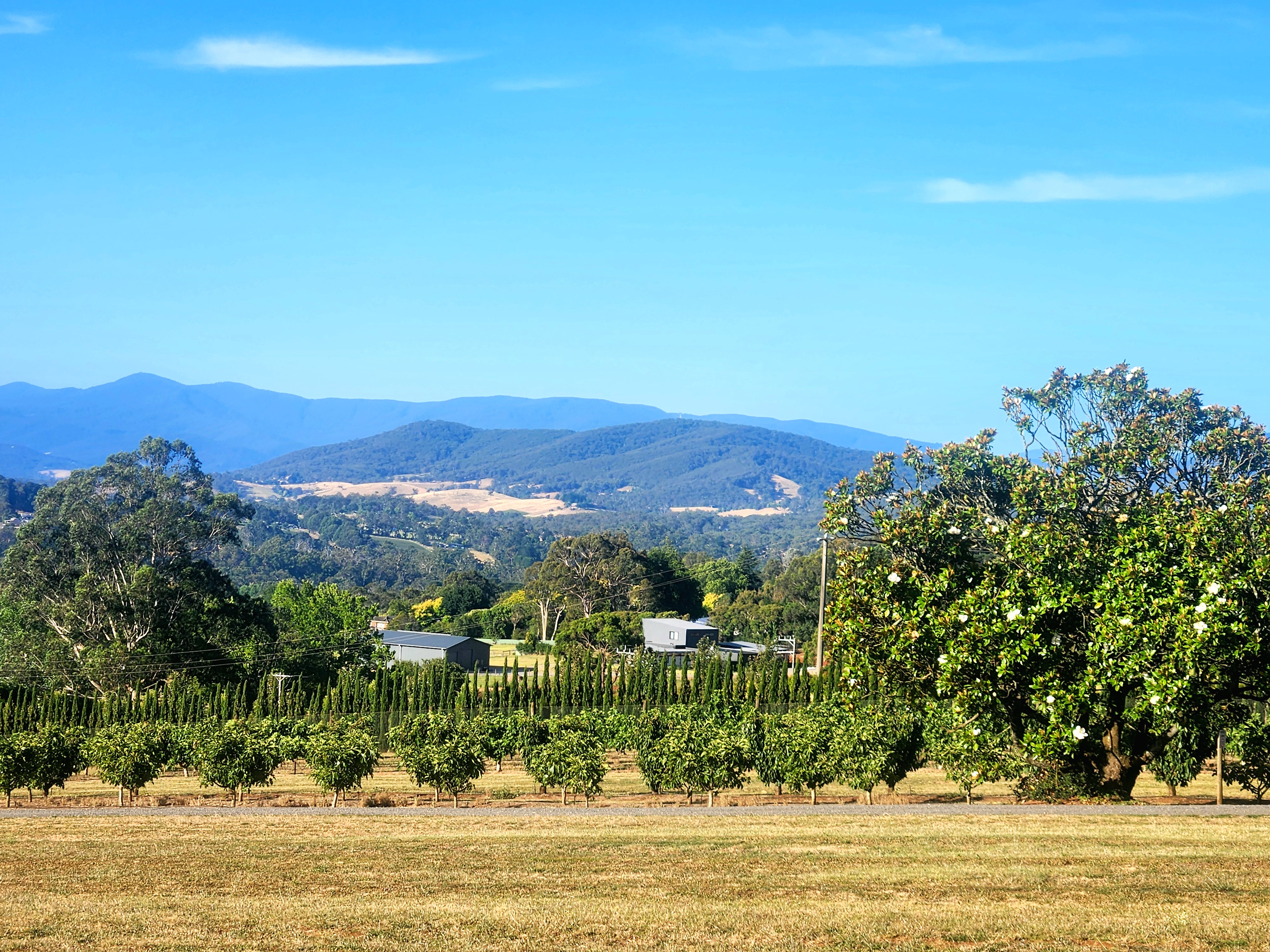
From the terrace, the views stretched across rolling vineyards and olive groves, their lines flowing with the natural curves of the land.

Beyond them, the hills shimmered in the afternoon light, a reminder of just how blessed this region is with both beauty and bounty.

It was the kind of place that made you want to linger — not just for the wine, but for the peace that seemed to hang in the air, wrapped in birdsong, blossoms, and the soft rustle of leaves in the breeze.

Soon after leaving the vineyard, the road carried us through a small, picture-perfect town called Clarendon. It looked as though it had dressed especially for spring, every corner bursting into bloom.

The streets and driveways were lined with blossom trees, their branches heavy with flowers, creating soft tunnels of pink and white.

It was the kind of scene that makes you slow the car almost without realising, just to take it all in. Clarendon felt like a little jewel tucked into the hills, charming and radiant in the season’s full embrace.

By early afternoon we reached Hahndorf, our home for the next two nights. Our Airbnb cottage is tucked just off the main street, a sweet little place that welcomed us with its cosy charm.

It feels like the perfect base — close enough to wander into town yet far enough to retreat into quiet at the end of the day. After dropping our bags and catching our breath, curiosity got the better of us. With the main street only one over, we headed out on foot.

Hahndorf’s personality revealed itself almost instantly.

The leafy streets, heritage buildings, and character-filled shopfronts created a charming scene.

Together, they formed a blend of history and hospitality that gives the town its heart.

Hunger nudged us quickly toward a local German hotel dining room, called German Arms Hotel, where the promise of a hearty country meal was too tempting to resist.

The plates were generous, the flavours rich and comforting, and the atmosphere warm — the kind of dinner that leaves you satisfied.

Afterwards, we strolled along the shopfronts.

Timber beams, flower boxes, and old stone facades hinted at the stories and traditions woven into this town.

As we wandered, it felt as though we were stepping not only into a new place, but into a rhythm that belonged entirely to Hahndorf — part village, part living museum, and completely captivating.

No sooner had we returned to our cottage than the rain started, tapping against the windows. It was as though the day had waited for us to come home before drawing the curtains.


Leave a Reply to AnonymousCancel reply